
Suggested Reading
From time-to-time we find articles or social media posts that truly capture the essence of our own Tai Chi philosophy and provide useful insight into many of the concepts that we focus on in class - from beginners to those with years of Tai Chi and martial arts experience. We appreciate and give credit to the work that others are doing to promote Tai Chi and are pleased to share their voices and insights here.
Taiji Through Time — A Living Art in Continuous Transformation
There is often a tendency to think of Taiji as something static, an ancient art created long ago in a perfect form and simply repeated ever since. But if we truly look at its history, we see the exact opposite. Taiji has never been fixed. From its earliest beginnings until today, it has constantly evolved, adapted, transformed, and moved through different societies, cultures, and human needs.
Perhaps this is precisely why it survived.
Before Taijiquan existed in the form we recognize today, China already had many practices combining breath, movement, meditation, martial training, and internal cultivation. People at that time had a completely different relationship with the body. They worked physically, walked long distances, lived close to nature, and depended on the body for survival every single day.
These practices were not created as “wellness” methods or escapes from stress. They were systems of survival, health cultivation, martial preparedness, internal refinement, and spiritual discipline.
Later, in Chen Village, what we now recognize as Taiji began to take shape. There, the art was deeply martial. It included explosiveness, fajin, spear principles, push hands, conditioning, and combat application. The slow practice already existed, but it was never the entire art. Taiji at that time was not simply “gentle exercise.” It was profound and demanding training of both body and mind.
With Yang Luchan, a major transformation took place. Taiji moved from the village into the city. It began to be taught to aristocrats and the imperial guard. Its external aesthetic changed. The movement became smoother, more continuous, and more refined, adapting to different bodies and social environments. The martial essence did not disappear, but the outward expression evolved.
In the early twentieth century, China underwent enormous political and social changes, and Taiji increasingly became associated with public health and national revitalization. The art opened to the wider public, and gradual simplification began. Later, during the Communist era, simplified forms were created so Taiji could be taught to large populations. This likely saved the art from disappearing, but at the same time many deep martial and internal elements were reduced or removed.
When Taiji spread to the West in the 1970s and beyond, it became connected with spirituality, anti-stress culture, and alternative healing. This created both misunderstandings and new possibilities. In recent years, another transformation has emerged. The modern era of nervous system regulation, fascia research, embodied awareness, and longevity culture has made Taiji relevant once again. Many people today are searching not only for fitness, but for ways to reconnect with their bodies, calm the nervous system, and recover a sense of presence within an overstimulated world.
Throughout all these historical changes, evolution never stopped — not even within the lineage families themselves. Tradition is often misunderstood as something frozen and unchanging. Yet historically this was never true. Every generation of teachers reorganized, simplified, emphasized different elements, and created new pedagogical methods according to the needs of their time and students.
This continues today.
Within the Dong Family system, Alex Dong has developed and organized contemporary forms and methods such as the Simplified Form, the Advanced Form, the Hefa Form, and the Taiji Fundamental Qigong. These forms did not appear randomly. They represent an effort to make the art more accessible to modern practitioners, to organize teaching more effectively, and to gradually build the body and internal understanding.
The Simplified Form functions as an entrance into the art. Through it, students cultivate relaxation, balance, body connection, breathing, and the fundamental relationship between the center and the limbs.
The Advanced Form introduces greater complexity, deeper body mechanics, coordination, martial intent, and internal connection.
The Hefa Form is particularly important because it organizes essential Taiji principles around gathering and release, closing and opening. Through this process, practitioners begin to understand more deeply the nature of jin, the relationship between center and extremities, the opening and closing of the body, and the continuous transformation between yin and yang.
The Taiji Fundamental Qigong functions almost as a return to the foundations of movement and presence. In an age where many people are deeply disconnected from their bodies, these exercises help restore natural structure, awareness, breathing, and internal connection.
Today, Taiji is entering yet another period of transformation. Social media, artificial intelligence, short-form content, wellness culture, and algorithm-driven platforms are changing the way the art is presented. We increasingly see “Tai Chi hacks,” miracle claims, AI-generated teachers, and fast promises of transformation. Often, Taiji is reduced to a marketing aesthetic.
And yet, within all this noise, perhaps its deeper essence becomes even more important.
Because the more the modern world becomes faster, more digital, more anxious, and more disembodied, the more valuable genuine embodied practice becomes.
Perhaps the goal is not to preserve Taiji as a frozen artifact of the past.
Perhaps the real challenge is to preserve its living essence within new forms, new societies, and new bodies.
Maybe true tradition is not just the repetition of form.
Maybe it is the preservation of living experience.
Thank you all!
The Importance of Opening the Kua
Courtesy of Pampamisayoc Qi Gong/Facebook
If you practice Qi Gong, Tai Chi, or other Martial Arts… I’m sure you have heard about the Kua…
And the importance of training and opening the Kua…
The kua, the groin/hip juncture where the legs meet the pelvis, is a pivotal structural and energetic hub in Qi Gong and Tai Chi…
Functionally it links the rooting of the feet to the rotational and spiral power of the waist, enabling weight transfer, balance, and coordinated whole‑body movement…
An open, responsive kua receives incoming force, lets the weight settle, and transmits intent from the legs into the torso without rigid gripping…
This coordination underpins stable stances, fluid stepping, and the internal silk‑reeling mechanics that produce efficient movement and fa jin…
Training the kua emphasizes relaxation, sensitivity and integrated movement rather than brute strength…
Practices begin with breath‑linked awareness… placing hands lightly on the upper inner thighs while breathing to invite softening and release…
Standing practices such as zhan zhuang cultivate passive strength and receptive tone… standing with knees soft and attention at the kua teaches the area to bear weight without tension…
Small pelvic rotations and silk‑reeling exercises develop spiral connectivity… make very small waist‑led circles so the inner thighs and groin trace the movement…
Dynamic drills reinforce functional transfer…
Slow step‑and‑settle walking teaches how weight lands in the kua… stepping deliberately and pausing to feel the weight settle trains neural patterns for balance and rooting…
Single‑leg balances stress the kua’s role in support… practising micro‑bends and relaxation in the supporting hip helps stabilise the pelvis without locking the knee…
Partner work or gentle push‑hands allows application… when receiving, direct force into the kua and ground it through the feet rather than meeting force with arm strength…
Progress is gradual… initial focus is awareness and gentle mobility, advancing to integrated movement and resistance…
Common mistakes are gripping the groin, collapsing the knee, or pushing from the shoulders… these indicate poor kua function and should be corrected with reduced range, relaxation cues, and guided practice…
Trained kua yields better balance, fluidity, and efficient internal power in both Qi Gong and Tai Chi…
Consistent practice over weeks improves the kua’s openness, enhancing stability, posture and resilience while strengthening subtle energetic connections central to regular daily Qi Gong and Tai Chi practice…
Do you open your Kua in training and practice?
No Resistance - The Invisible Strategy
Note from Sifu Bearg: This is written about Akido but could just as well be abou Tai Chi.Courtesy Facebook: Akido San LuisBecoming Shodan
Courtesy: Akido Advice for Women…and a Few MenMark Wiley interview with Master Alex Dong on what actually changes physically through the practice of Tai Chi.
innerlifewithmarkwiley.com (Video and transcript included in link)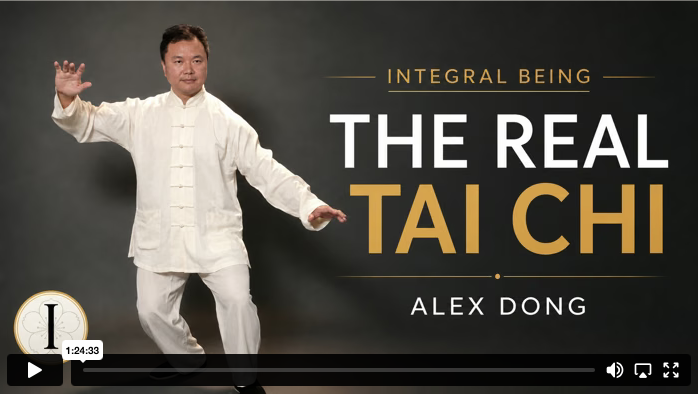
Long-Term Health Preservation Through “Opening the Three Gates”
Theory and Practical Application in Tai Chi Chuan
Courtesy: Tai Chi: Beyond the HealthTraditional Tai Chi Basic Curriculum
Tai Chi Beyond The HealthThe Training Philosophy of Master Dong Yingjie in Taijiquan
Tai Chi Beyond The HealthGran Master Alex Dong’s Father performing the Slow Set.
What really is JIN in Tai Chi?
Damon Bramich, Educational Resource Center